
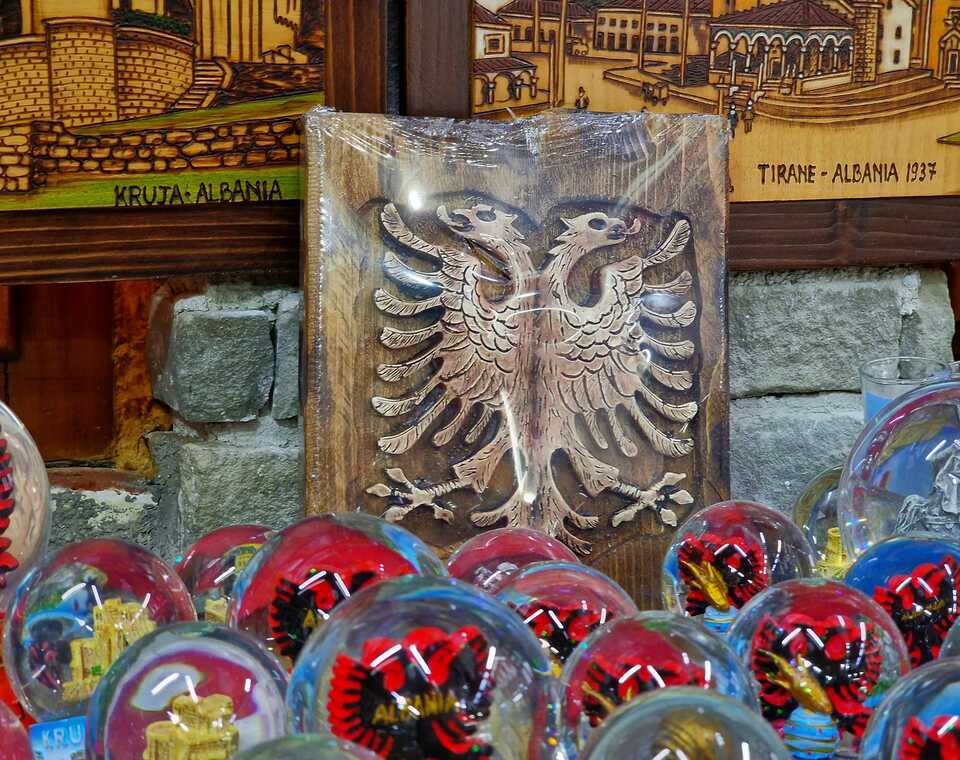
For all of you over the world, who do not have the opportunity to travel in Albania, think again.
1-) The last battle between Caesar and Pompey (Roman Time) took place in the territory of Albania, near the Kavaja Rock. This happened in the year 48 B.C. and ended with the victory of Caesar. The rock of Kavaja in antiquity was known as “Petra”. Near this Rock, Caesar had set up his camp.
2-) Albania is home to the three largest, deepest and highest tectonic lakes of Europe. These are, Shkodra Lake, which lies in the northwest of the country with an area of 368 Km2. 149 km2 belong to Albania, the rest to Montenegro. Ohrid Lake, with 358 km², Catchment area: 2,600 km², Length, 30.4 km, Surface elevation: 693 m, Max. depth, 300 m (980 ft). Prespa Lake, with surface area of the larger lake, 176.3 km2 (68.07 sq mi), 46.3 km2 (17.88 sq mi) 36.4 km2 (14.05 sq mi). We share this lake with Greece and North Macedonia.
3-) Sailing through the artificial lake of Koman you will enjoy a typical landscape of “fjords” in the heart of the Mediterranean. This lake was formed in 1986 by the Drin River, as a result of the construction of the Koman Hydropower Plant. The lake is located between valleys and canyons of rare beauty. Rocky shores drop sharply over the lake creating stunning scenery. Sailing on this lake connects Shkodra and Tirana with the city of Bajram Curri and the area of Tropoja.
4-) Karavasta Lagoon is the western most point in Europe where the Curly Pelican (pelicanus crispus) which is considered their home. This lagoon has been under the RAMSAR International Convention since 1994. The lagoon itself has an area of 4,330 hectares, constituting at the same time the largest lagoon on the Albanian coast. It is one of the 12 national parks of Albania. It is quite pleasant to observe closely the pelicans in question. They usually sit on a small sandy island in the lagoon, also known as the “Pelican Island”. You can go to it by boat. Here is 15 percent of the world number of this species. Karavasta Lagoon is a very important natural ecosystem for other habitats as well.
5-) The Albanian language is based on Pelasgian (Iliyrian Tribe). The latter are the bearers of the Neolithic culture and the beginning of the Bronze Age in the territory of Albania. Discoveries of this culture have been found in Podgorie, Kolsh etc. Albanian language is considered one of the most difficult languages in the world and has nothing in common with the languages of the countries around us. Albanian is considered an isolate within the Indo-European language family; no other language has been conclusively linked to its branch.
6-) In Durrës is the Roman amphitheater which is the second largest in the Balkans. The amphitheater was built in the 1st century A.D., in the period of the Roman emperor Hadrian. It has a capacity of 15-20 thousand seats. In terms of construction style it resembles the monuments of Pompeii and Capua in Italy. In the 10th century, a “hat” was built in his galleries, which is famous for its rare wall mosaics.
7-) Some of the songs of the southern regions of Albania are song without musical instruments. This type of interpretation is called “iso-polyphony”. The latter is “Part of the masterpieces of human oral heritage” and is protected by UNESCO as a world value. Iso polyphony is song in the southern part of Albania known as “Toskëria”. Especially this form of interpretation is known in the province of Labëria. Usually in Albania during the month of November in the city of Vlora takes place the “National Folklore Festival of iso – polyphony”.
😎 The ancient city of Butrint, mentioned by the poet Virgil in his poem “Aeneid”, otherwise known as a “Second Troy”, together with the museum city of Gjirokastra are included in the UNESCO World Heritage List. Butrint was a fortified city of the Kaon tribe, one of the largest tribes of southern Illyria. The archaeological heritage of Butrint is one of the most important archaeological sites in the country, containing different artifacts and structures, dating from the Iron Age up until the Middle Ages. Numerous monuments are still extant including the city walls, a late-antique baptistery, a great basilica, Roman theater and two castles. The ancient city is situated within a natural woodland with a complex ecosystems which depends on the nearby lake and channel. Nevertheless, it is this combination of cultural monuments and natural environment which makes Butrint such a unique place.
9-) The National Hero of Albania, Gjergj Kastrioti, or “Scanderbeg” is known as “the defender of European Christianity. He organized a successful resistance for 25 years by stopping the Ottomans from continuing their invasion to the Europe. He defeated the Ottomans three times during the sieges of Kruja in 1450, 1475 and 1467. Scanderbeg Statue are found in many World cities. Geneva – Switzerland, London – England, Brussels – Belgium, Rome – Italy, Budapest – Hungary, Paris – France, Skopje – Northern Macedonia, Pristina – Kosovo, Michigan – USA. Also, Vivaldi has written the famous Opera, Scanderbeg.


